


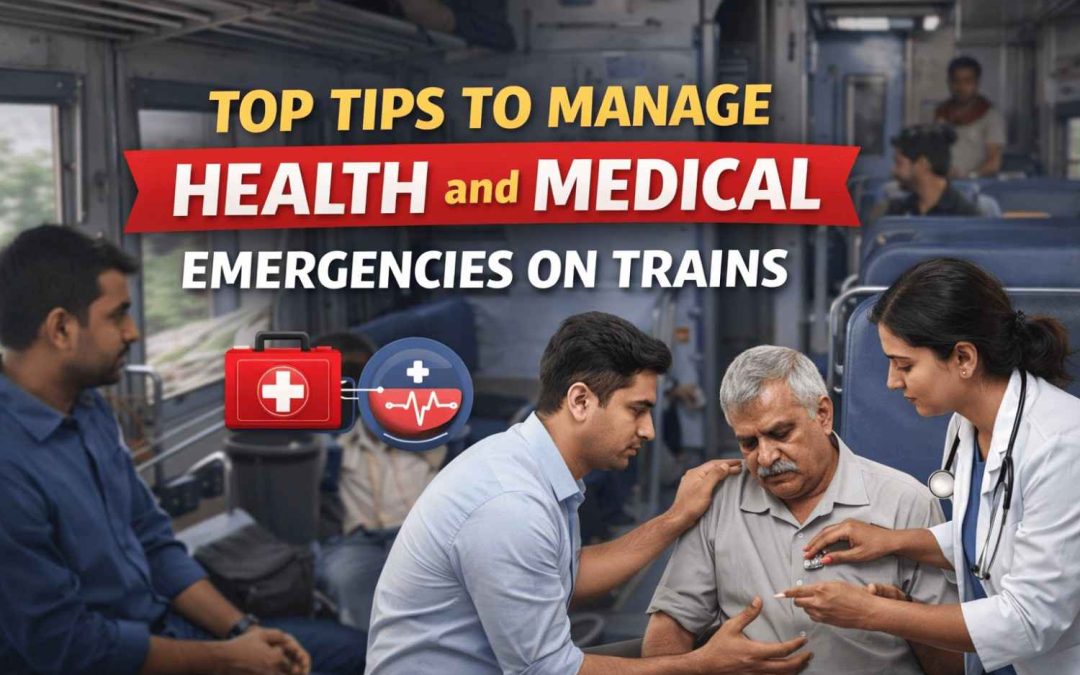
Medical Emergency Tips on Trains
While traveling by train it is common for a passenger to become unwell or suffer an injury. While this is a fairly common occurrence it can also cause significant distress. At such times people can become extremely nervous but there is no need to panic. Correct information and appropriate action can be extremely helpful to you and others.

In this blog we cover what to do in case of a medical emergency on a train, the available facilities and how to quickly obtain help.
Stay calm and understand the situation
If a medical emergency occurs while traveling on a train, do not panic. Panic can make the situation worse.
First, check the patient’s condition and see whether they are breathing properly or not.
- Is there any serious condition such as unconsciousness, dizziness, chest pain, injury, or bleeding?
- If the patient is able to speak, ask them immediately what the problem is.
Inform the TTE or train staff immediately
If you face any problem on the train, contact the TTE first.
Ask for help immediately.
The TTE informs the station master and control room, and they arrange medical assistance at the next station.
Call the Railway Medical Helpline
If the situation is getting serious, call this number immediately:
Railway Emergency Helpline – 139
By calling this number, you can get medical help, a doctor at the next station, an ambulance, or any required assistance. You can also contact IRCTC customer service as an option.
Use railway station-level medical facilities
As soon as the TTE informs the control room:
- A doctor, medical team, or ambulance is arranged at the upcoming nearest station.
- Many major stations also have railway hospitals or medical rooms.
You only need to give complete and correct information so that help reaches you at the right time.
Use the basic first-aid available on trains
Most trains have a first-aid box that contains:
- Bandages
- Cotton
- Ointment
- Basic medicines
- Antiseptic
The train staff or TTE provides these items when required. If you forgot medicines, use the “Medicine Delivery in Train” service. Nowadays, with the help of IRCTC and some private companies, medicines are delivered to your seat during the journey.
You can order medicines by providing your train details, PNR, and the name of the medicine. The medicine is delivered to your seat from the nearest station.
This service is very helpful for passengers who forget regular medicines like BP, Diabetes, or Asthma medication.
In serious conditions, request “Emergency Help in Train”
If the patient shows symptoms like severe chest pain, difficulty breathing, continuous bleeding, unconsciousness, or food poisoning, inform the TTE about the serious emergency.
In such cases, the train is stopped at the nearest station and a medical team is provided.
Seek help from fellow passengers
Many times doctors or nurses may also be traveling in the same train. If someone falls ill, the staff can make a public announcement and ask for help from any doctor on board. Trained passengers can also help during first-aid.
Keep some basic preparations yourself
If you are going to travel by train, carry a small medical kit with you:
- Painkillers
- ORS
- Band-aid
- Cotton
- Antiseptic
- Motion sickness medicine
- Your regular BP/Diabetes/Thyroid medicines
These things can provide initial help in many situations.
Pay special attention to elderly passengers, children, and patients
If you are traveling with young children or elderly people:
- Give them water from time to time
- Be careful with food and drinks
- Ensure proper seating or lying arrangements during long journeys
This helps prevent small problems from turning into bigger issues.
Be careful with food and drinks
Many emergencies happen because of poor eating habits.
- Do not eat street food or low-quality food.
- Rely only on packed water or railway-approved stations.
- Avoid eating very heavy meals during travel.
Follow train staff instructions
Every train has safety and medical guidelines.
- If the staff asks you to vacate a seat so the patient can lie down, cooperate with them.
- When a doctor or medical team arrives, give them space and do not crowd around.
Social media or IRCTC apps also help
- The IRCTC Rail Connect App has a help section.
- On X (Twitter), you can tag @RailMinIndia or @IRCTCofficial for help. Railway officials respond very quickly.
Conclusion
Anyone can face a medical emergency during a train journey. At such times, the right information, patience, and timely actions can even save a life. Informing the TTE, calling helpline 139, using first-aid, and requesting station-level assistance when needed are all important steps.
Along with these, modern services like Medicine Delivery in Train and Emergency Help in Train make passenger safety and convenience even easier. The right information and a little caution can make your journey safe, comfortable, and stress-free.
